
Micro vs Mini Futures: Which Contracts to Trade on a Funded Account
ES or MES? How micro and mini futures compare, and how to size your trades so they fit your funded account's loss limits.
Every futures trader eventually faces the same question: should I trade the full-size E-mini contract, or its smaller sibling, the Micro?
On a funded account, the answer matters more than ever. Your daily loss limit, your maximum drawdown and your contract limits are all fixed numbers. The contract you choose decides how precisely you can size your risk inside those numbers, and that often decides whether you reach your payout or not.
This guide explains how micro and mini futures work, compares the most traded contracts side by side, and shows exactly how to size positions on a HyperTicks futures account.
What Are Mini and Micro Futures?
E-mini futures are the standard contracts most active futures traders use, such as the E-mini S&P 500 (ES) or the E-mini Nasdaq-100 (NQ). They track the same index as the full-size contracts, at a size that suits individual traders.
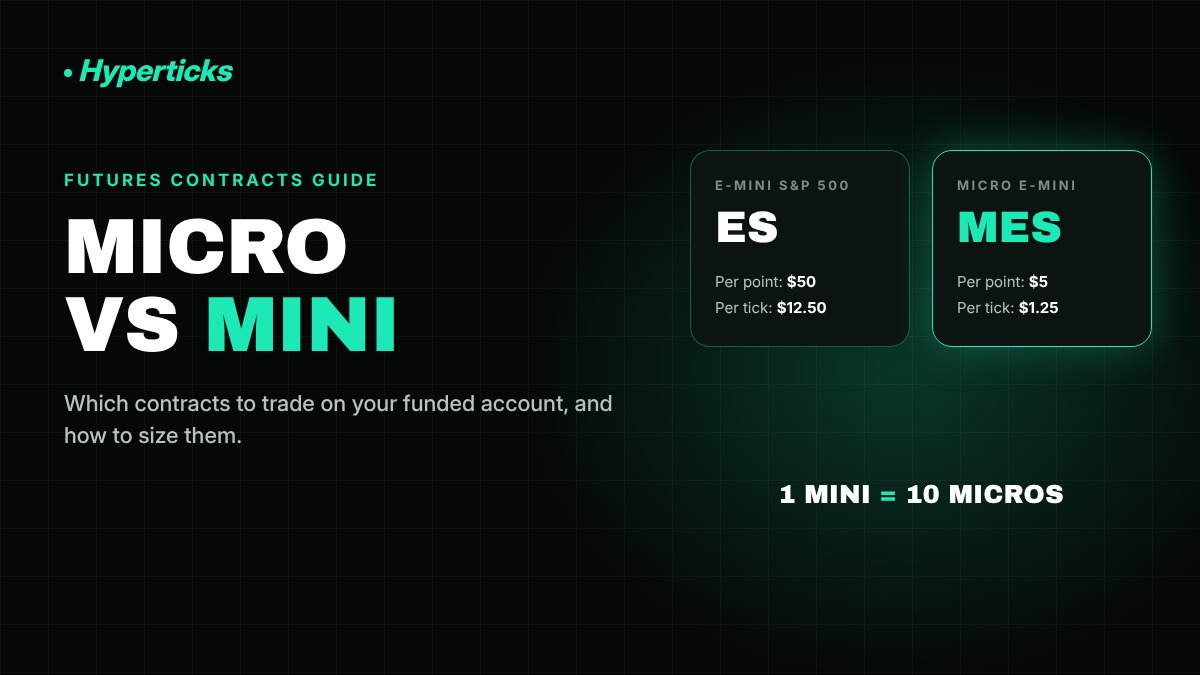
Micro futures are exactly one tenth of the E-mini. Same market, same price, same chart, same trading hours. The only difference is the dollar value of every move.
The Most Traded Contracts, Side by Side
| Market | Mini | Value per point | Micro | Value per point |
|---|---|---|---|---|
| S&P 500 | ES | $50 | MES | $5 |
| Nasdaq-100 | NQ | $20 | MNQ | $2 |
| Dow Jones | YM | $5 | MYM | $0.50 |
| Russell 2000 | RTY | $50 | M2K | $5 |
| Crude oil | CL | $1,000 per $1.00 | MCL | $100 per $1.00 |
| Gold | GC | $100 per $1.00 | MGC | $10 per $1.00 |
And the smallest possible move, one tick, in dollars:
| Contract | Tick size | Tick value (mini) | Tick value (micro) |
|---|---|---|---|
| ES / MES | 0.25 points | $12.50 | $1.25 |
| NQ / MNQ | 0.25 points | $5.00 | $0.50 |
| YM / MYM | 1 point | $5.00 | $0.50 |
| RTY / M2K | 0.10 points | $5.00 | $0.50 |
| CL / MCL | $0.01 | $10.00 | $1.00 |
| GC / MGC | $0.10 | $10.00 | $1.00 |
Standard CME contract specifications. Check the trading platform for the instruments available on your account.
Why Contract Size Matters on a Funded Account
Let's take a real example: the HyperTicks Beginner Standard $50K account.
| Rule | $50K Beginner Standard |
|---|---|
| Profit target | $2,500 (5%) |
| Daily loss limit | $1,000 (soft breach) |
| Maximum loss | $2,125 (end-of-day trailing) |
| Max contracts in evaluation | 3 minis or 30 micros |
Now imagine you trade the S&P 500 with an 8-point stop loss.
With 1 ES, that stop is worth $400. That's 40% of your daily loss limit and almost 19% of your maximum loss on a single trade. Five losing trades in a row and the account is gone. And you can't go any smaller: one mini is the minimum.
With MES, you choose exactly how much to risk:
| Contracts | Risk with an 8-point stop | Share of max loss | Losing trades before max loss |
|---|---|---|---|
| 1 ES | $400 | 18.8% | 5 |
| 5 MES | $200 | 9.4% | 10 |
| 3 MES | $120 | 5.6% | 17 |
| 2 MES | $80 | 3.8% | 26 |
Example based on the $50K Beginner Standard maximum loss of $2,125. Losing trades rounded down.
Same trade, same setup, same stop. With micros, your risk fits your plan instead of the contract deciding it for you.
Sizing by Risk, Not by Contract
The best way to use micros is to start from the dollar amount you want to risk, then calculate the number of contracts:
Example: you want to risk $200 per trade on MES (worth $5 per point).
| Stop distance | Risk per MES contract | MES contracts for ~$200 risk |
|---|---|---|
| 4 points | $20 | 10 |
| 8 points | $40 | 5 |
| 10 points | $50 | 4 |
| 20 points | $100 | 2 |
With a wider stop, you trade fewer contracts. With a tighter stop, more. Your risk in dollars stays the same on every trade, which is exactly what keeps a funded account alive.
When Minis Make Sense
Micros aren't always the better choice. Minis can be the right tool when:
- Your account is larger. On a $100K account with a $3,250 maximum loss, one ES with a tight stop can still fit comfortably within your risk plan.
- You've built a profit cushion. Once your balance is well above your loss limit, a mini may fit your plan where it didn't on day one.
- You want to keep things simple. One mini instead of ten micros means fewer contracts to manage on screen.
Many traders combine both: they start on micros, build a cushion, and move up to minis as their account and confidence grow.
Contract Limits on HyperTicks Accounts
Every HyperTicks futures program has clear contract limits, expressed in minis or micros. A few examples:
| Program | $25K | $50K | $100K |
|---|---|---|---|
| Beginner Standard (evaluation) | 1 mini / 10 micros | 3 / 30 | 6 / 60 |
| Beginner Standard (funded) | 1 / 5 | 3 / 15 | 6 / 30 |
| Instant Pro+ | 2 / 20 | 4 / 40 | 8 / 80 |
On Beginner, Beginner Max and HYPER accounts, your contract limit also grows with your profit. On a $100K account, for example, you start with up to 2 minis or 20 micros, and can trade up to 6 minis or 60 micros once you've made $4,000–$6,000 in profit.
| Profit made | $50K | $100K |
|---|---|---|
| Under $1,000 | 1 mini / 10 micros | 2 / 20 |
| $1,000 – $2,000 | 2 / 20 | 3 / 30 |
| $2,000 – $4,000 | 3 / 30 | 4 / 40 |
| $4,000 – $6,000 | — | 6 / 60 |
Limits as published by HyperTicks at the time of writing. Funded-account limits may differ from evaluation limits; always check the rules of your program.
This is where micros shine again: as your limits grow, micros let you scale up gradually, contract by contract, instead of jumping straight from one mini to two.
A Few Rules to Keep in Mind
- Trading hours: futures trade from 18:00 to 16:10 New York time. Open positions are closed automatically at 16:10, and that automatic close is not a breach.
- News: around tier-1 news releases, don't modify your stop loss or take profit in the 5 minutes before or after the event.
- Stay active: place at least one trade every 7 days to keep your account active.
- No microscalping: high-frequency trades held for only a few seconds with tiny targets are not allowed. Normal short-term trading is fine.
Trade Futures with HyperTicks
- $0 activation fees on every futures account: pass, and your funded account is ready.
- 90% profit split on most futures programs.
- Programs for every style: Beginner plans for traders starting out, HYPER programs with no daily loss limit, and Instant accounts with no evaluation.
- No consistency rules on HYPER Pro, HYPER Intra and Instant programs.
- Payouts twice a month, withdrawable via crypto wallet or Rise.