
How to Scale to $1M in Funding by Stacking Funded Accounts
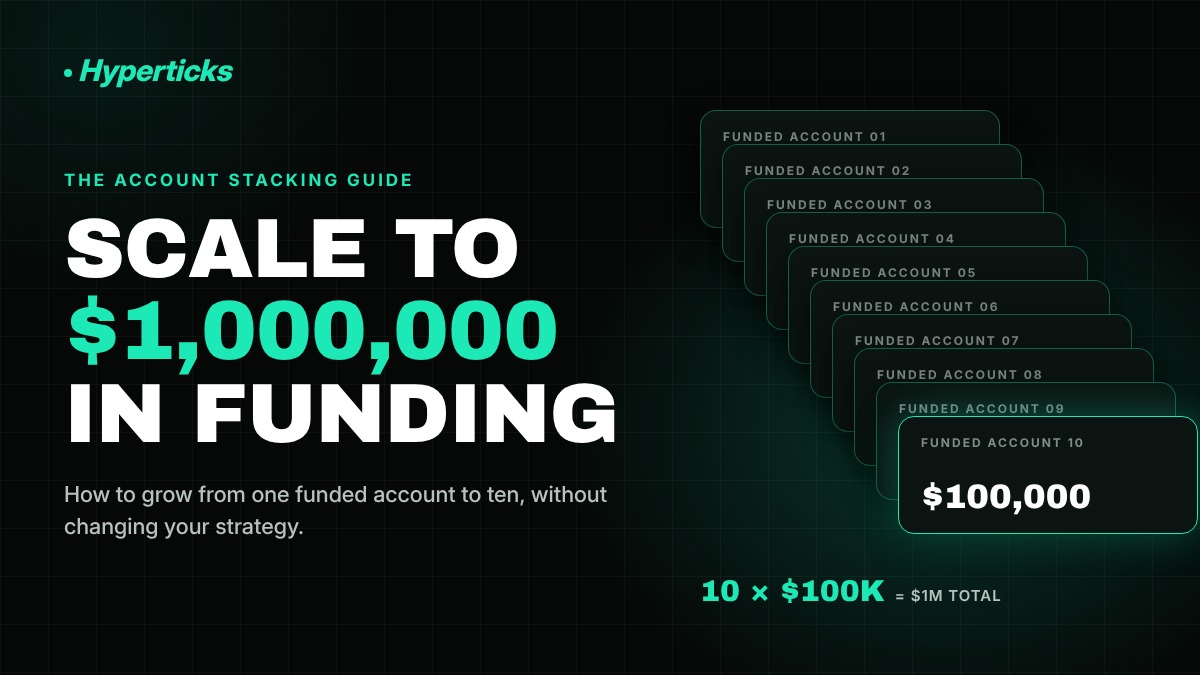
How to grow from one funded account to ten and up to $1M in total funding, without changing your strategy or your risk.
Most traders think about scaling the wrong way. They pass one challenge, then start looking at bigger and bigger account sizes, as if the only way to grow is to jump from $50K to $200K and hope their strategy holds up under the pressure.
There's a smarter way, and it's the one experienced funded traders use: stacking. Instead of one big account, you run several funded accounts side by side, trading the same strategy you already trust. Your risk per account stays small and familiar. Your total capital grows with every account you add.
At HyperTicks, you can stack up to 10 accounts, with up to $1M in total funding. This guide shows you exactly how to get there: how stacking works, how to plan your risk across accounts, the order to build them in, and the mistakes that cost traders their accounts.
What Is Account Stacking?
Account stacking means holding more than one funded account at the same time, usually trading the same setups across all of them.
Think of it this way. If your strategy makes 3% in a good month, the size of that month depends entirely on how much capital the strategy is running on:
| Setup | Total capital | 3% month (gross) |
|---|---|---|
| 1 account | $100,000 | $3,000 |
| 3 accounts | $300,000 | $9,000 |
| 5 accounts | $500,000 | $15,000 |
| 10 accounts | $1,000,000 | $30,000 |
Illustrative figures before profit split. Results depend entirely on your trading.
Same strategy. Same trades. Same risk per trade on each account. The only thing that changes is how many accounts the strategy is running on.
Why Stacking Beats One Big Account
1. Your risk stays the same size
Moving from a $50K to a $200K account means every position, every stop loss and every drawdown limit becomes four times bigger in dollars. Many traders who handle $50K perfectly start hesitating at $200K. With stacking, each account stays at a size you're comfortable with. You're not trading bigger. You're trading the same, more times.
2. One bad day doesn't end everything
With a single large account, one rule breach and your whole funding is gone. With several accounts, a mistake on one doesn't touch the others. Your business keeps running while you rebuild the account you lost.
3. You can grow step by step
You don't need to buy ten accounts on day one. You can add one at a time, using your results and your payouts to fund the next evaluation. Your funding grows at the same pace as your confidence.
4. More accounts, more payouts
Every funded account has its own payout cycle. More accounts mean more payouts, which gives you steadier income and less pressure on any single month.
Plan Your Risk Before You Stack
This is the part most traders skip, and it's the most important one. When you trade the same setups across several accounts, your accounts are correlated: a losing trade loses on every account at once.
That's fine, as long as you plan for it. The key rule:
Here's how a typical losing streak looks across stacked accounts, using an example of 0.5% risk per trade:
| Losing streak | Drawdown per account | Accounts still alive |
|---|---|---|
| 3 losses | 1.5% | All of them |
| 6 losses | 3.0% | All of them |
| 10 losses | 5.0% | Depends on your drawdown limit |
Example figures. Always check the exact drawdown rules of your program.
If 10 losses in a row would take you close to your limit, it would do it on every account at the same time. That's why stacked traders usually keep risk per trade at the lower end of their range, and set a personal daily stop well before the firm's limit.
The Stacking Roadmap: From 1 Account to 10
There's no single right way to do it, but this is the path most consistent traders follow.
Stage 1: Prove it on one account
Start with a single account at a size you're comfortable with. Pass the evaluation, get funded and trade it through at least one payout cycle. You want proof that your strategy works under the rules, with real consistency, before you multiply it.
Stage 2: Add a second and third account
Once you've received a payout, add one or two more accounts. This is where you learn the practical side: managing several accounts at once, keeping risk identical, tracking each account's drawdown. Keep the same account size you already know.
Stage 3: Build to five
With three accounts running smoothly, scaling to five is mostly about routine. Many traders use their payouts to fund each new evaluation, so their growth pays for itself.
Stage 4: Scale to ten
The final stage is about consistency and discipline. At ten accounts and up to $1M in total funding, your process matters more than any single trade. Same setups, same risk, same rules, every day.
| Stage | Accounts | Main goal |
|---|---|---|
| 1 | 1 | Pass, get funded, receive a first payout |
| 2 | 2–3 | Learn to manage several accounts at once |
| 3 | 4–5 | Build a routine, let payouts fund new accounts |
| 4 | 6–10 | Scale to up to $1M with a repeatable process |
How to Manage Multiple Accounts
Running several accounts is simpler than it sounds, as long as you keep it organized.
- Use a trade copier where your program allows it. Many traders place trades on one account and mirror them to the others. It saves time and keeps every account identical. Always check the program rules on copy trading first.
- Keep every account on the same risk settings. Same risk per trade, same stop loss logic, same instruments. Differences between accounts make them harder to track.
- Track each account's drawdown separately. A simple sheet with each account's balance, daily limit and maximum limit takes two minutes a day and removes almost all of the stress.
- Stagger new evaluations. Running one or two evaluations at a time while your funded accounts trade normally keeps things manageable.
- Use the same platform and setup for every account. Fewer moving parts, fewer mistakes.
5 Stacking Mistakes to Avoid
1. Scaling before you have consistency
Ten accounts multiply a profitable strategy. They also multiply an unprofitable one. Get at least one payout before you stack.
2. Raising risk because you have "more capital"
Your capital grew, but each account's drawdown limit didn't. Keep risk per account exactly where it was.
3. Treating accounts differently
Taking extra trades on one account "because it's in profit" breaks the system. Every account follows the same plan.
4. Ignoring correlation
Ten accounts trading the same setup are, in practice, one big position. Plan your daily stop with that in mind.
5. Buying all ten at once
Growing step by step lets you learn, adjust and let your payouts fund the next account. There's no prize for getting to ten in a week.
Why Traders Stack with HyperTicks
We built HyperTicks for traders who want to grow, and our programs are designed to make stacking work:
- Stack up to 10 accounts, with up to $1M in total funding.
- Zero payout denial policy. Trade within the rules, and you get paid. On every account.
- No consistency rules on most programs. A strong day counts, on one account or on ten.
- No activation fees on futures accounts. When you pass, your funded account is ready. No extra cost per account, which matters even more when you're running several.
- Competitive pricing on futures programs, including plans built for traders starting out with futures, and across our CFD programs.
Whether you trade futures or CFDs, you can start with one account today and build toward ten at your own pace.
Frequently Asked Questions
How many accounts can I have at HyperTicks?
You can stack up to 10 accounts, with up to $1M in total funding.
Do I need to buy all my accounts at once?
No. Most traders start with one account, receive a payout, and then add accounts step by step.
Can I use a trade copier across my accounts?
Many traders do. Always check the rules of your specific program on copy trading before you set it up.
Should I use the same risk on every account?
Yes. Keeping the same risk per trade on every account makes them easier to manage and protects each one from your worst realistic losing streak.
Are there activation fees when I pass a futures evaluation?
No. HyperTicks charges no activation fees on futures accounts.
Do HyperTicks programs have consistency rules?
Most of our programs have no consistency rules, so a strong trading day always counts toward your results.
Trading involves risk. The figures in this article are illustrative examples and do not represent guaranteed results.